Signing Off With a New "Four Easy Steps"
A final post, a recap of a simple climate story, and a thank you


It is time to bring this site to an official close. Thanks for a great run! I hope these essays may continue to be useful, informative and maybe sometimes even fun. We know a lot about climate and climate change, and have known much of it for a long time. Maybe telling the story in a simpler way can help us put that knowledge to work.
A Final Post
Exactly 5 years ago today, I posted the first essay to this Substack site with the goal of providing less inflammatory (Less Heat) and more informative (More Light) writings on weather, climate and climate change.
This will be the last post.
It has been an enjoyable project and I have learned a lot. I hope you have found these essays useful as well. Feedback from you has been positive and rewarding. Thank you!
Essays and data will remain available
While there will be no more of these essays dropped in your mailbox, I hope some will continue to be used in discussions, presentations and classrooms. They will remain online here for as long as Substack allows. Indexes to all the essays, to the “top 30” most frequently read posts, and even a book-formatted, downloadable and printable file of the “top 30” are available on the website (phrases in color here here are embedded live links to essays on each topic - references and sources are to be found in those individual posts).
You are free to use any and all posts - all for free!
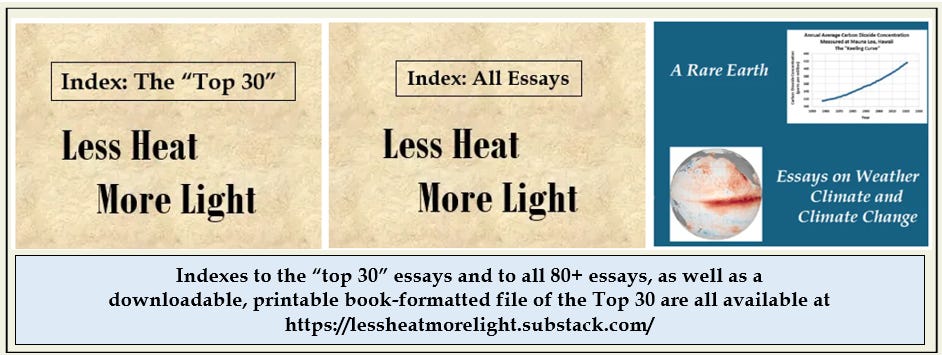
Many of these essays draw on a structured data archive capturing long-term measurements of change in 14 crucial global change variables. That data set has been updated through the end of 2025 and is also available for download. Because all of those indicators have been changing continuously, some for more than 65 years, older essays have not been edited to include the latest numbers as the major points in those stories would not change!
A simple climate change story
These posts provide details and data supporting what is essentially a simple story based primarily on direct measurements. You might notice the absence of complex climate models in these essays. I have tried instead to bring “quantitative reasoning” into the mix and have even suggested that we view data graphs, of which there are so many in these essays, as you would works of art in a gallery.
An updated “Four Easy Steps” in this simple climate story are:
1. Climate change is happening, and we are the cause
All the major indicators of global change have been changing continuously, many for more than 65 years. Carbon dioxide, temperature, ice loss, ocean heat storage, sea level rise, number of tropical storms and many other measures all follow the same pattern. And even the minimal variation in the year-to-year increase in global mean surface temperature can be made less variable by adding a relationship with the status of the El Niño/La Niña oscillation.
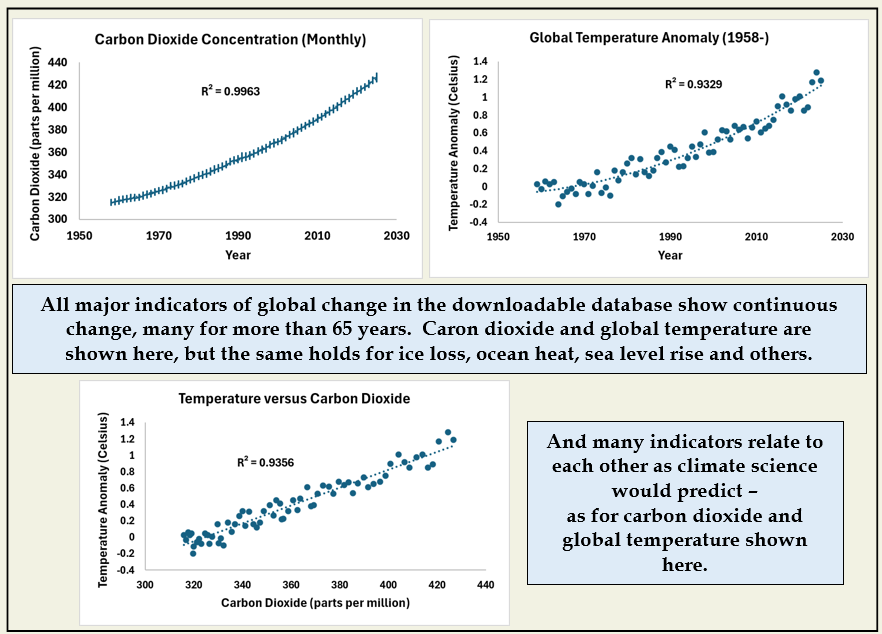
We are causing those changes by increasing the concentrations of greenhouse gases in the atmosphere – mostly as a byproduct of the global energy system.
2. No tipping points but powerful momentum
The amazingly continuous rate of change in the primary indicators show that there have been no tipping points and suggest none into the future, but also that there is tremendous momentum behind these changes. A clear acceptance of the science and a coordinated global effort will be required to alter our trajectory
Unfortunately, slow, continuous change does not make for good headlines, so we will continue to see stories about tipping points and imminent disaster, while ignoring the real threat – change has been relentless and will continue. There is no going back, but we can change the arc of the future.
If there was a tipping point, it was when the industrial revolution switched from water power to coal and steam in the 1800s.
3. There are hopeful signs
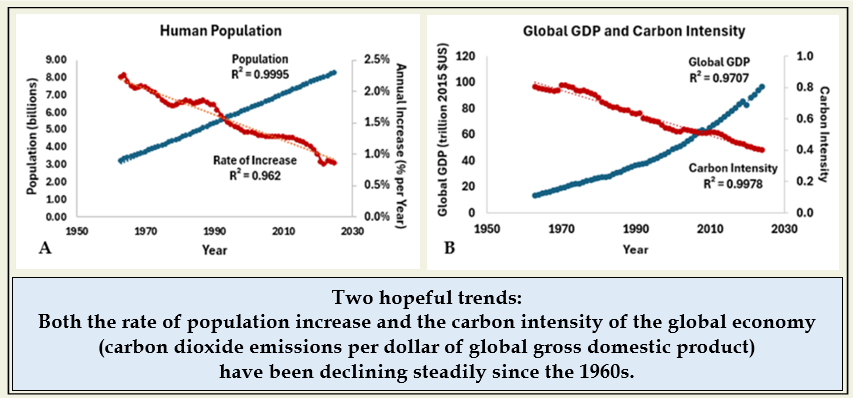
Two additional, consistent global trends offer glimpses of a more hopeful future. Both the rate of human population increase and the carbon intensity of the global economy have been declining steadily since the 1960s. If these two trends continue on their current trajectories, they predict a world with a stable population and a carbon neutral economy by 2070.
4. And an “easy” solution - the sun
We have more than enough energy given to us every day from the sun to power that growing but low-impact global economy. Even after accounting for interference from the atmosphere and a 25% efficiency for converting sunlight to electricity, it would take less than 1% of the land area of the Earth to produce as much energy as we now consume globally.
For the U.S., converting just 50% of the land currently used to grow corn for ethanol from corn farms to solar farms could meet all our energy needs. Some of this conversion is already happening as the economics of agriculture and energy change.
Weather-makers and some personal reflections
These climate change stories have been built on the foundation of hopefully simple and clear explanations of many of the major weather-makers that operate within the context of the changing climate system, including Jet Streams, the Gulf Stream, El Niño/La Niña, Atmospheric Rivers, the Polar Vortex, and others.
And some more reflective pieces have tried to capture how rare and precious this one planet may be, that simple explanations are often the best, and that some aesthetic and personal aspects of weather and climate, like the color of autumn foliage, may be changing as well.
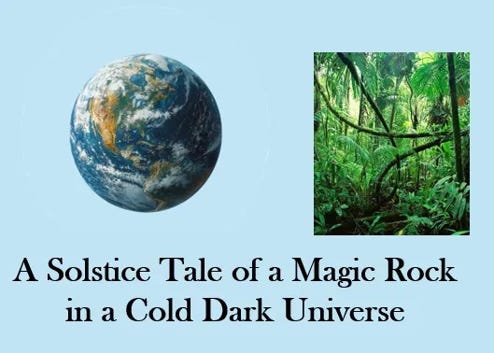
And surprisingly, this solstice tale has been one of the most popular posts! It is also available to download in a printable book format.
So, thanks once more…
for reading these essays over the last 5 years, and here’s hoping that we can work together towards a brighter climate future with Less Heat and More Light.
Thank you John for the wonderful essays and your insights and perspective on climate change. I have certainly learned a lot and have referred back to your essays (and book) to answer questions from family and friends many times. I will miss the essays in my inbox, but wish you all the best in this next phase!